Loading...

Light + Space

Altman Siegel / 2025
gdm 爍樂 / 2024
MOK Köln / 2025
LACMA / 2025-26
Kyoto, Shibunkaku 思文閣
Ryosoku Temple 兩足院
Beijing, 2018
Light and Space, 2015
Shanghai 2016 -2017
Houston 2017
Hong Kong 2012
Shanghai 2011
Asian Art Museum, 2020
Chicago, 2018
Hong Kong 2022
Shanghai 2022

Solo Exhibition
Los Angeles County Museum of Art (LACMA), 2025-26

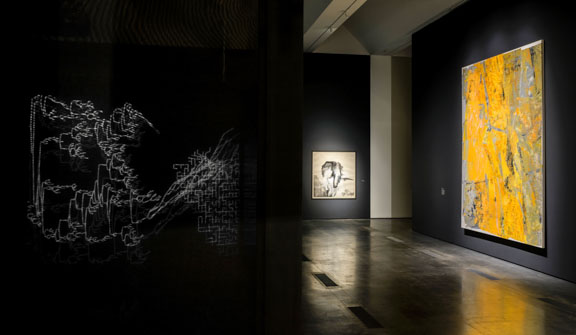
Zheng Chongbin: Golden State—which features pieces from LACMA's collection, promised gifts to LACMA from the Fondation INK Collection, and generously loaned works—highlights a range of Zheng's artistic production. The exhibition includes work the artist made in the late 1980s, just before his move to the U.S., alongside pieces created within the past year. Each is imbued with the liveliness of his materials and further animated by the agency and energy of the viewer.

Light and Space Installation
Museum für Ostasiatische Kunst Köln, 2025

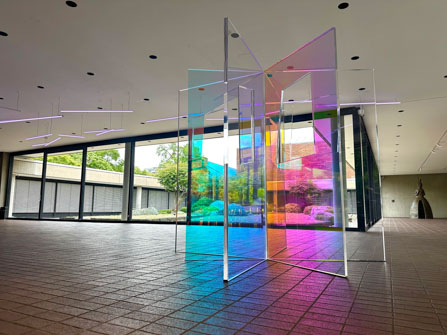
The freestanding acrylic glass sculpture consists of six radially and fan-shaped panels, supported at the base by stainless steel strips and connected at a central point. The panels vary in width and depth and are partially finished with iridescent colored foil. Each panel is perforated, featuring a unique, geometrically shaped, window-like cutout, reminiscent of James Turrell's iconic Skyspace works from the 1970s. The overall structure resembles a revolving door, which we activate step by step. Depending on our position, viewing direction, and focus, the six "windows" frame our views, glimpses, and perspectives. As we walk around the sculpture, the viewpoints and perspectives shift. The overlapping cutouts constantly create new refractions, juxtapositions, and distortions of the field of vision, and thus of spatial perception. Only through our looking and moving forward are the multiple scenes set in motion, image by image, or rather, image-within-an-image.

Light and Space Installation
gdm 爍樂, 2024

Immeasurable things inherently possess ambiguity. We're embracing these ambiguities that resonate with the complexity of existence. As a friend noted, "Life is about all kinds of ambiguity: ambiguous feelings, ambiguous situations." He reminds me of how the drawing is getting done. I draw multiple lines to bring forth the most accurate line. Precision emerges from the bundles of many fuzzy lines. Similar to a game of chess, I draw lines that intersect and diverge, reflecting interconnectedness and opening up possibilities. Then the merge of life becomes perceptible. Each line can influence and interact with another. In the realm of ambiguity, we find a signal of accuracy.

Video Installation
Altman Siegel, San Francisco, 2025

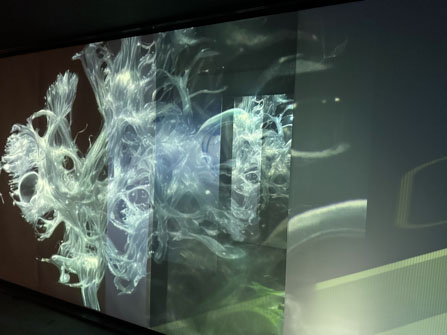
The elements around us contribute unique tactile sensations, nourishment, and vision, shaping life in all its forms. They range from natural constructs to human-made ones, influencing, altering, and even sustaining life. From cells and microbes to air, mist and light, from trees and soil to water, the tapestry extends to include human-generated products like cars, tools, alloys, and synthetic materials. Each element plays a role in the ongoing transformation and interconnection of our bodies and the environment. This dynamic landscape represents how these elements coexist—both independently and intricately.

Light Space Installation
Hong Kong Museum of Art (HKMOA)- Oct 2022 - Oct 2023

Inspired by the new spatial perspective and the scenery of the HKMoA, the artist meticulously makes use of light and shade, multimedia images and mixed media to connect the views of Victoria Harbour and the HKMoA interiors from the past, the present to the future by layers of artistic sceneries created, and to juxtapose with the Museum collection on display in harmony. This creates dialogues across time, space, mediums and cultures, curating a world of contrasts at sight, perception and bodily experience.

Site Specific Light and Space Installation
Shanghai Library East - 2022

With Flying Stone, this surreal art landscape simulation of the information age civilization myth causes the audience to think about nature, life, and civilization. The myriad of things originated from not only the earth's ecology but also extraterrestrial bodies. From dust to ice, from magnetic gravity to dark matter, from photosynthesis to microbial origins. Moreover, human and non-human beings are moving in and out of heaven and earth, living in the annulus and repeating’.

Light Space Installation
Asian Art Museum - Jan 2021

Art has always been a pathway to this fuzzy world. It's full of probabilities and chance – and so it was, working on this installation. The assembled fragmented pieces were never about fixing the object itself, bur rather about the shifting relationship among the fragments, a resonance, a natural chemistry. Culture and nature need to share the same space; society, all living beings, this physical planet, this earth, are interconnected. This is the puzzle, the challenge we face: to create patterns that are cognizant of what we affect and are affected by.We have seen the shift of what we thought we knew to the revelations of an unknown reality. Our pace is like an invisible, intertwined mesh – and this intertwining comes with complex interactions among multiple entities.

Light and Space Installation
Kyoto - April 2019 - Ryosoku - in temple 兩足院  

When I was making “Temple” I was struck by the impact of a  big storm on Kyoto. Everything was in chaos. So I was thinking about how the  tree branches and mosses were being cleared out and pruned back into shape, and  how those forms related to the fractal geometry in Hokusai’s “Great Wave,”  another moment of environmental chaos.

Light and Space Installation
Kyoto - April 2019 - Ryosoku - in temple 兩足院  

Flow as the basis for being or becoming emerges naturally from the chaotic and ordered, entropic and emergent interactions of ink in water. I believe that ink and water can reveal the connection between our living environment and our lived experience in a way that seeks communication or communion rather than control.

Light and Space Installation
Beijing, 2018

The embodied experience of light and shadow have functioned as central metaphors throughout the history of philosophy from Shakyamuni Buddha’s “Shadow Cave” to Plato’s “Cave of Shadows.” Only Zhuangzi, however, makes the penumbra—the luminous border between light and shadow—his central image for our existence; it being at once entirely co-emergent and co-dependent on the world from which it emerges and yet entirely self-realizing and self-so within its own experiential context.

Light and Space Installation
Art Basel, Hong Kong, 2017
Orange County Museum of Art, 2016

Black bleeds into white with a liquid grace. The surface of the rice paper becomes mountain ranges, valleys, and striated ground, shuddering as it swells with ink. A formless horizon, a flash of light, blinding white gives way to a hand holding an invisible brush, painting the shadow forms of mountains and water—shan-shui, the Chinese word that signifies landscape. This landscape, however, is not primarily composed of images. It is a series of homologous flows and processes that give way to shape-shifting forms. It is an amalgam of intensities flowing at a common frequency. Busy red blood cells merge and morph into vermilion ink moving in rivulets across rice paper, swollen with fluid.

Light and Space Installation
11th Shanghai Biennale,
Shanghai, 2016-2017

Wall of Skies is not about dualities, but continuities and fluidities. It features a monumental, multi-planar work of ink on paper within a constructed enclosure of a semi-reflective floor and slanted walls. The walls draws us along its rising and falling contours, and close towards its surface textures-vein-like fractal patterns and creases created through the absorption of ink by fibrous xuan paper. Despite its industrial scale and fabrication, its ethereal illumination recalls the West Coast light and space movement and, more distantly, the atmospheric effects of the artist's home of the San Francisco Bay Area. Without one-point perspective and architectural framing, the space is remarked by continually navigating the installation at different scales and from different vantages.

The largest Digital Art Projection in history
Chicago, IL, 2018

Art on the MART is the largest permanent digital art projection in the world, projecting contemporary artwork across the 2.5-acre river-façade of theMART.

Permanent Light and Space Installation
Houston TX, 2017

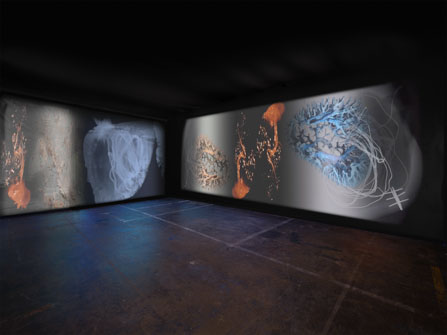
Clusters of Memory incorporates elements such as ink, water, acrylic, paper, and light to emphasize memory in its physical form as a neural function, and in its less concrete forms as shared experiences and transmitted remembrances. The juxtaposition of digital and natural components renders the presumed boundary between organic life forms and technology more permeable, perhaps suggesting a greater, unified whole.

Light and Space Installation
San Francisco, 2011

White Ink, the Painter is Absent. White Ink debuts fifteen new works Zheng created as a site-specific installation that includes video projections and paintings.

Light and Space Installation
Hong Kong Art Center, 2012

By removing the control of the content, size, timing, color, this work serves as an arbitrary devise that manifested the adaptabilities with restriction to others or even to the self. It projects a type of living environment whether the consequences of our ideas are accepted or rejected.  As a form of censoring devise, it is an inhibiting force in mind that transform into our daily life.